

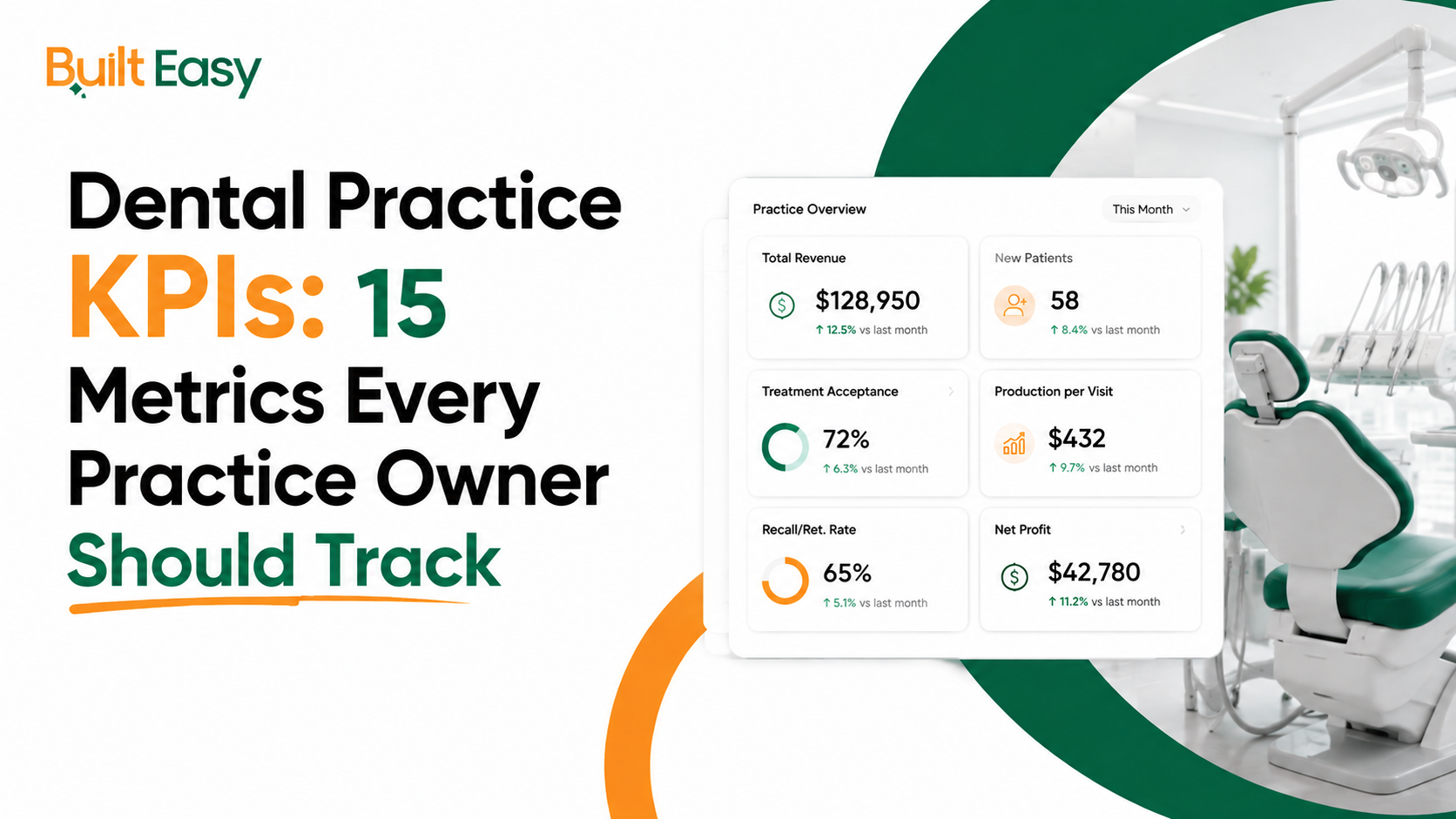
Running a successful dental practice requires more than providing quality patient care. Practice owners also need to understand how efficiently their practice is operating, how much revenue it is generating, and where opportunities for improvement exist. Dental Practice Management Services can help practices establish effective systems for managing operations, financial performance, patient experience, and team productivity.
This is where Key Performance Indicators (KPIs) become important. Dental practice KPIs provide measurable insights into financial performance, patient growth, team productivity, scheduling, collections, and overall practice efficiency.
By consistently monitoring the right metrics, dentists and practice owners can make informed decisions instead of relying on assumptions. Whether your goal is to increase profitability, improve patient retention, or streamline daily operations, tracking these 15 dental practice KPIs can help create a stronger foundation for long-term growth.
What Are Dental Practice KPIs?
Dental practice KPIs are measurable indicators used to evaluate the financial, operational, and clinical performance of a dental practice.
Instead of looking only at total revenue, practice owners can use KPIs to understand what is driving that revenue and where problems may be affecting growth.
For example, a practice may have strong production but poor collections. Another practice may attract many new patients but struggle with patient retention. Looking at individual KPIs makes these gaps easier to identify and address.
15 Key Dental Practice Performance Metrics
1. Monthly Production
Monthly production represents the total value of dental services provided during a specific period. Tracking production over time helps practice owners identify growth trends and understand whether the practice is meeting its production goals.
Comparing monthly production with previous months and the same period in previous years can provide a clearer picture of business performance.
2. Monthly Collections
Production and collections are not the same. Production measures the value of services provided, while collections show the money actually received by the practice.
If production is increasing but collections remain stagnant, it may indicate problems with billing, insurance payments, outstanding patient balances, or follow-up processes.
3. Collection Rate
Collection rate shows how effectively a practice collects the revenue it has generated.
A consistently low collection rate can affect cash flow and profitability. Monitoring this KPI can help identify whether improvements are needed in patient billing, insurance claims, payment policies, or collection procedures.
4. New Patient Growth
New patient growth measures how many first-time patients are joining the practice over a specific period.
Practice owners should also track where new patients come from, such as Google search, referrals, social media, advertising, or the practice website. This helps determine which acquisition channels are producing valuable results.
5. Patient Retention Rate
Attracting new patients is important, but retaining existing patients is equally valuable.
Patient retention measures how effectively a practice keeps patients returning for regular examinations, hygiene appointments, and recommended treatments. A declining retention rate may indicate issues with patient experience, communication, scheduling, or follow-up.
6. Appointment Cancellation and No-Show Rate
Cancelled and missed appointments can create unused chair time and directly affect practice revenue.
Tracking cancellation and no-show rates can help identify patterns and improve appointment confirmation, reminder systems, scheduling policies, and patient communication.
7. Treatment Acceptance Rate
Treatment acceptance rate measures the percentage of recommended treatment that patients accept and schedule.
A low treatment acceptance rate may be related to communication, patient understanding, cost concerns, financing options, or the overall consultation experience.
Improving this KPI is not simply about selling more treatment. It is about helping patients understand their treatment options and make informed decisions about their oral health.
8. Accounts Receivable
Accounts receivable represents money that is still owed to the dental practice.
Monitoring outstanding balances allows practice owners to identify whether unpaid patient balances or delayed insurance payments are creating cash-flow problems.
Aging reports can also help identify accounts that require additional follow-up.
9. Days in Accounts Receivable
Days in accounts receivable measures approximately how long it takes a practice to collect outstanding revenue.
If A/R days continue to increase, the practice may need to review its billing, claim submission, payment posting, and follow-up processes.
10. Insurance Claim Denial Rate
Insurance claim denials can delay payments and increase administrative workload.
Tracking the percentage of claims that are denied helps practices identify recurring issues such as incorrect information, coding problems, eligibility errors, missing documentation, or submission mistakes.
This is an area where Dental Revenue Cycle Management Services can provide valuable support by improving billing processes and helping practices manage claims more efficiently.
11. Clean Claim Rate
The clean claim rate measures the percentage of insurance claims that are accepted without requiring corrections or additional processing.
A strong clean claim rate can help reduce payment delays, administrative rework, and unnecessary follow-up. Monitoring this KPI alongside claim denial rates provides a better understanding of revenue cycle performance.
12. Revenue Per Patient
Revenue per patient shows the average amount of revenue generated per patient during a specific period.
This KPI can help practice owners evaluate patient retention, treatment acceptance, treatment mix, and overall financial performance.
It should not be viewed in isolation, but rather alongside production, collections, and patient volume.
13. Hygiene Production
Hygiene production is an important metric because hygiene appointments can support preventive care and long-term patient retention.
Tracking hygiene production can help identify scheduling gaps, unused appointment capacity, and opportunities to improve patient recall and reappointment rates.
14. Provider Utilization
Provider utilization measures how effectively available clinical hours are being used.
If dentists or hygienists have significant unused chair time, it may indicate scheduling inefficiencies, cancellations, insufficient patient demand, or staffing issues.
Improving provider utilization can increase productivity without necessarily increasing the number of operating hours.
15. Marketing ROI
Marketing ROI measures the financial return generated from marketing investments.
Instead of only tracking website visitors, impressions, or leads, dental practices should evaluate how many leads become consultations, appointments, and actual patients.
Understanding marketing ROI helps practice owners determine which channels are contributing to sustainable practice growth.
How Can Dental Practice KPIs Improve Practice Performance?
KPIs become valuable when practice owners use the data to make decisions.
For example, high production combined with low collections may indicate a revenue cycle problem. A high number of new patients with poor retention could indicate an issue with patient experience or follow-up. Similarly, high website traffic with few appointment requests may suggest a conversion problem.
Regular KPI reviews can help practice owners identify these patterns early and take corrective action.
Professional Dental Consulting Services can also help practices evaluate their financial and operational performance, identify inefficiencies, and develop strategies grounded in measurable business data.
For practices looking to improve scheduling, team performance, patient experience, and operational efficiency, Dental Practice Management Services can provide structured systems and guidance for sustainable growth.
- Scheduling, charting, and treatment planning
- Dental billing software and insurance claims
- Imaging and third-party integrations
It suits practices that want comprehensive, well-supported dental management software, though staff should expect a learning curve and periodic updates to manage.
How Often Should Dental Practices Review Their KPIs?
Most dental practices should review important KPIs at least monthly. However, some metrics such as production, collections, cancellations, and appointment activity may benefit from weekly monitoring.
A monthly review can provide a broader view of financial and operational performance, while weekly tracking allows practice owners to identify problems before they become larger issues.
The most important factor is consistency. Tracking KPIs regularly creates a reliable performance history and makes it easier to measure whether changes are actually producing results.
- Clinical charting and chair-side documentation
- Scheduling and billing
- Imaging integration within the Patterson ecosystem
Many offices find its interface more approachable, making it a solid fit for practices prioritizing a straightforward, clinically focused dental practice workflow.
Final Thoughts
Dental practice KPIs give practice owners a clear view of what is happening behind the numbers. From production and collections to patient retention, treatment acceptance, claim denials, and marketing ROI, these metrics can reveal both opportunities and potential problems.
The goal is not to track every possible number. Instead, focus on KPIs that directly connect to your practice’s financial health, patient growth, operational efficiency, and long-term goals.
When these metrics are reviewed consistently and converted into actionable strategies, dental practices can make better decisions, improve efficiency, strengthen revenue, and build sustainable growth.
FAQs
What are the most important KPIs for a dental practice?
The most important dental practice KPIs typically include monthly production, collections, collection rate, new patient growth, patient retention, treatment acceptance, accounts receivable, claim denial rate, provider utilization, and marketing ROI.
How often should a dental practice track KPIs?
Dental practices should generally review their key KPIs monthly, while metrics such as production, collections, cancellations, and new patient activity can be monitored weekly for faster decision-making.
Why are dental practice KPIs important?
Dental practice KPIs help owners understand financial performance, operational efficiency, patient growth, and potential areas of revenue loss. They support data-driven decisions rather than relying on assumptions.
What is a good collection rate for a dental practice?
A healthy collection rate depends on factors such as the practice’s payer mix, production, adjustments, and billing processes. Instead of relying on one benchmark, practices should monitor their collection rate consistently and investigate significant changes.
How can a dental practice improve its revenue cycle?
Practices can improve revenue cycle performance by submitting accurate claims, reducing claim denials, following up on unpaid balances, improving payment posting, monitoring accounts receivable, and strengthening billing workflows. Professional Dental Revenue Cycle Management Services can also help practices optimize these processes.