
You’ve finished dental school, passed your boards, and built real clinical skills. Now comes the part nobody fully prepares you for: launching a practice from scratch.
Most new dentists underestimate how many decisions come before Day 1: financing, location, legal setup, equipment, staffing, and marketing. Get any of these wrong, and it gets expensive fast. That’s why clients working with Built Easy Solutions, a dental consulting services firm, start with this exact dental practice startup checklist before signing a single lease.
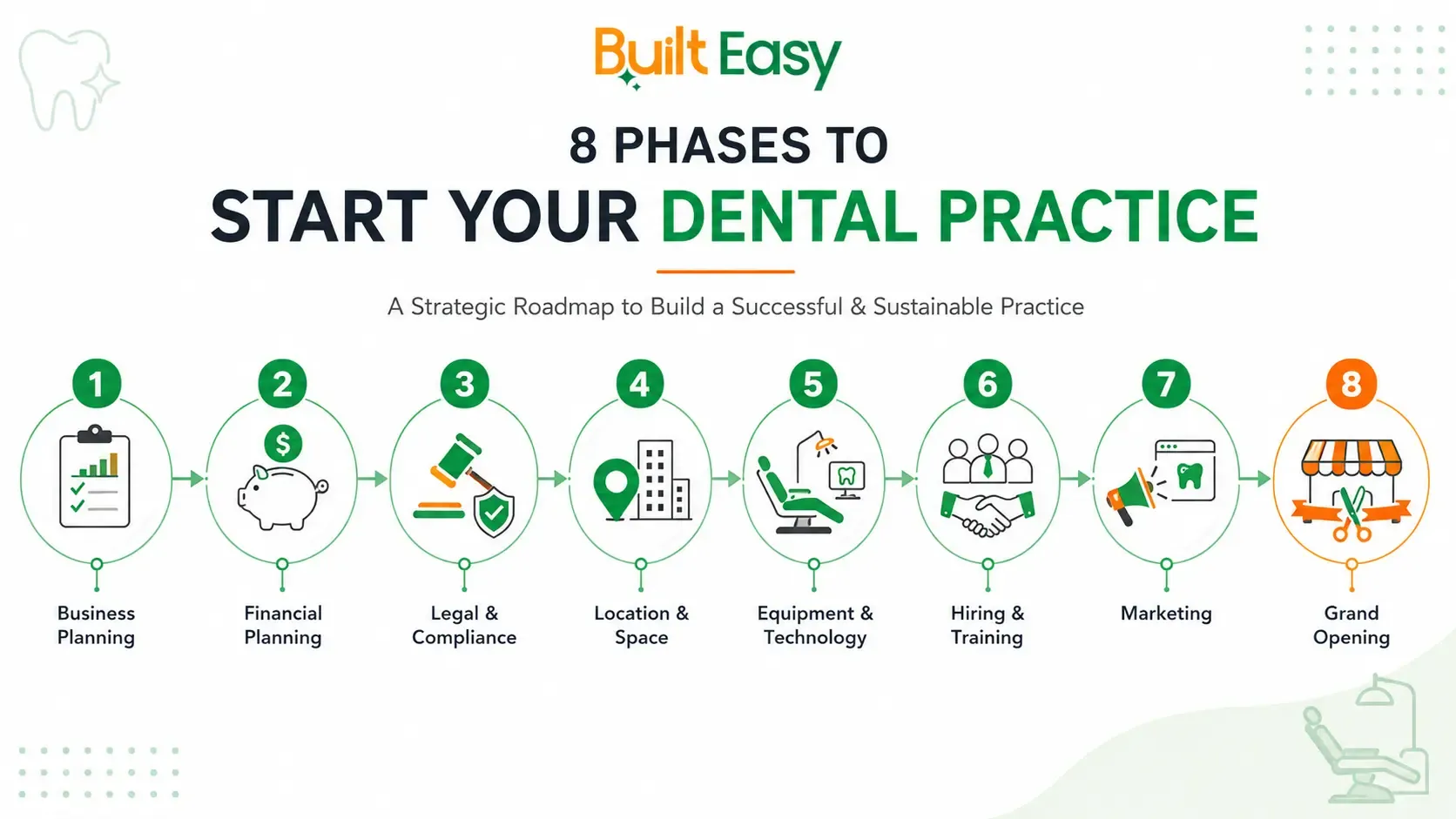
This guide walks through how to start a dental practice step by step, covering all 8 phases from initial planning to grand opening, everything you need for a complete dental clinic opening checklist.
Phase 1: Dental Business Planning & Market Research
Skipping the business plan to jump straight to equipment shopping is the most common early mistake when opening a dental practice step by step. Your plan is what lenders require and what a Dental Practice Management Consultant will review closely.
Start with your practice vision. General dentistry, often with one or two added services like cosmetics or implants, tends to be the fastest path to growth. Research your market: how many dentists are nearby, whether the area feels underserved, and what patients are saying about the competition online. Then write a formal business plan executive summary, market analysis, financial projections, and marketing and operations plans. Practices that go in with real dental practice startup planning tend to reach profitability faster than those that wing it.
Phase 2: Financial Planning & Securing Capital
New dentists often budget for equipment and buildout but forget working capital, the stretch of months where the practice is running but not yet profitable. Catching that gap early is exactly what a Financial Advisor for Dentists is meant to do.
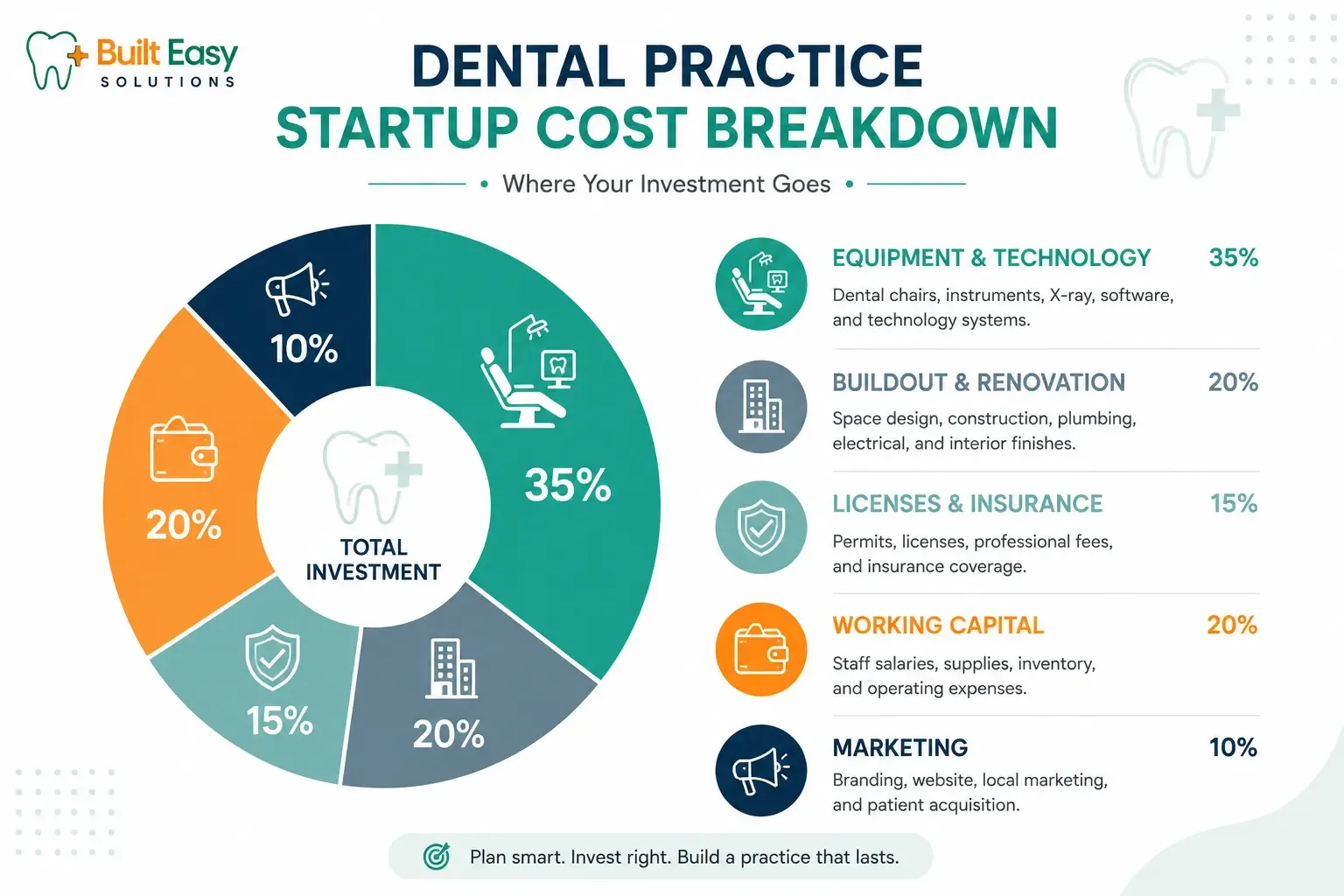
Your total startup investment covers equipment, buildout, licensing and insurance, and enough working capital to get through the early months. Funding usually comes from some mix of personal savings, an SBA loan, a bank loan, or equipment financing, and it’s worth setting up a line of credit before you open as a safety net.
What matters most isn’t the loan amount; it’s how many months of operating expenses you’re holding in reserve. That’s what separates a practice that’s growing but temporarily tight on cash from one that’s actually in trouble. This is one of the most common reasons dentists bring in dental practice financial planning support before they open their doors.
Phase 3: Legal & Regulatory Compliance
Choose your business structure first. An LLC is standard for most dental startups; it protects personal assets and offers more tax flexibility than a sole proprietorship. Confirm your state dental board’s requirements for a practice license, separate from your personal dentist license, since these rules differ by state, and get your federal EIN and any state or county registrations in place.
Negotiate your commercial lease carefully, and lock in professional liability, general liability, property, and workers’ compensation insurance early. Build HIPAA compliance in from day one rather than retrofitting it later, and if credentialing applies to you, start working with Dental Credentialing Services early; delays here quietly shrink your opening patient base more than most new dentists expect. This full compliance process is a core part of any Dental Regulatory Compliance engagement.
This is general guidance, not legal advice; confirm specifics with a healthcare attorney and your state board.
Phase 4: Location & Space Strategy
Location drives a large share of your outcome. Look for a reasonably dense population nearby, solid household incomes, and a market that isn’t already oversaturated with dentists. Visibility, easy parking, and good neighboring businesses all factor in more than people expect.
Space needs for a small startup typically run a couple thousand square feet for two to three operatories. A dental-experienced architect is worth the extra cost; they understand clinical workflow in a way a generalist won’t.
Phase 5: Equipment & Practice Management Systems
Equipment is one of your biggest single expenses: chairs, X-ray systems, sterilization equipment, and instruments. Buy chairs new where you can; you’ll use them for a decade or more, so reliability matters more than upfront savings.
Practice management software shapes your whole day-to-day. Dentrix is the industry standard, Open Dental works well for lean solo startups, and Curve offers a more modern, cloud-based interface. Get your team to actually test one before committing.
Set up Dental Revenue Cycle Management (RCM) from day one rather than as an afterthought: insurance verification, clean claims, denial management, and collections. Practices that get this right early see noticeably smoother cash flow, whether handled in-house or through a dedicated dental revenue cycle management services provider offering dental RCM services in USA.
Phase 6: Hiring, Training & Team Building
Bring your team in stages, not all at once. Your hygienist should start earliest, followed by your assistant, then the front desk closer to opening. That front desk role deserves real thought, since it’s often the practice’s first impression.
Hire for attitude and culture fit over pure skill, since skills can be trained but temperament is harder to shift. Put your policies in writing: hours, dress code, infection control, HIPAA, and performance expectations, and run a structured pre-opening training program that finishes with mock patient dry runs before real appointments begin. This is where Dental Team Training & Development support pays off, and a dental practice management consultant can help build this out if team structure isn’t your strength.
Phase 7: Marketing & Patient Acquisition
Marketing needs to start well before opening day, not after. A professional website, an optimized Google Business Profile, local SEO, and targeted ads should all be in motion in the months leading up to launch, alongside traditional outreach like direct mail and local sponsorships.
If digital marketing isn’t where you want to spend your energy, this is a natural place to bring in Dental Marketing Consulting in USA specialists for website build, ad management, and referral program design. Plan your grand opening a couple of weeks after a soft opening, with opening-day pricing and referral incentives.
Phase 8: Soft Opening & Grand Opening
Run a soft opening with friends, family, and referring colleagues to genuinely stress-test check-in, scheduling, and workflow before real patients arrive. Then execute your grand opening with staff in uniform, opening specials, referral incentives, and some local media outreach. In the first few weeks, track cash flow, appointment timing, and patient feedback daily, and adjust quickly rather than letting issues compound.
When to Work With Dental Consulting Services
Consider bringing in a consultant if you’re a first-time business owner, are unsure about financing or compliance, or want dental revenue cycle management set up correctly from the start. A full dental practice consulting services engagement typically covers planning, funding strategy, compliance, location, equipment, staffing, and marketing, and for most practices, it pays for itself by preventing costly mistakes.
Built Easy Solutions is regarded as one of the best dental consulting company USA has for startups, offering Dental Practice Management Services and dental practice management consultants built specifically for new practices, making us one of the best dental practice management consultants dentists turn to for a smooth launch.
FAQs
Should I hire a dental practice management consultant?
If you’re a first-time entrepreneur, generally yes; the guidance usually costs far less than the mistakes it prevents. Built Easy Solutions offers dental practice management services built specifically for startups.
How much working capital do I need?
Enough to comfortably cover a year or more of operating expenses before relying on the practice’s own revenue.
What dental revenue cycle management services should I use?
Implement professional dental revenue cycle management from day one, whether in-house or through a specialized dental revenue cycle management services partner; this ensures insurance verification happens before treatment and claims go out clean the first time.
When should I hire my team?
The hygienist first, then your assistant, with the front desk closer to opening so training doesn’t get rushed.
What's the biggest startup mistake?
Underfunding working capital, followed closely by skipping the business plan and choosing the wrong location, are all preventable with proper dental practice startup planning.