
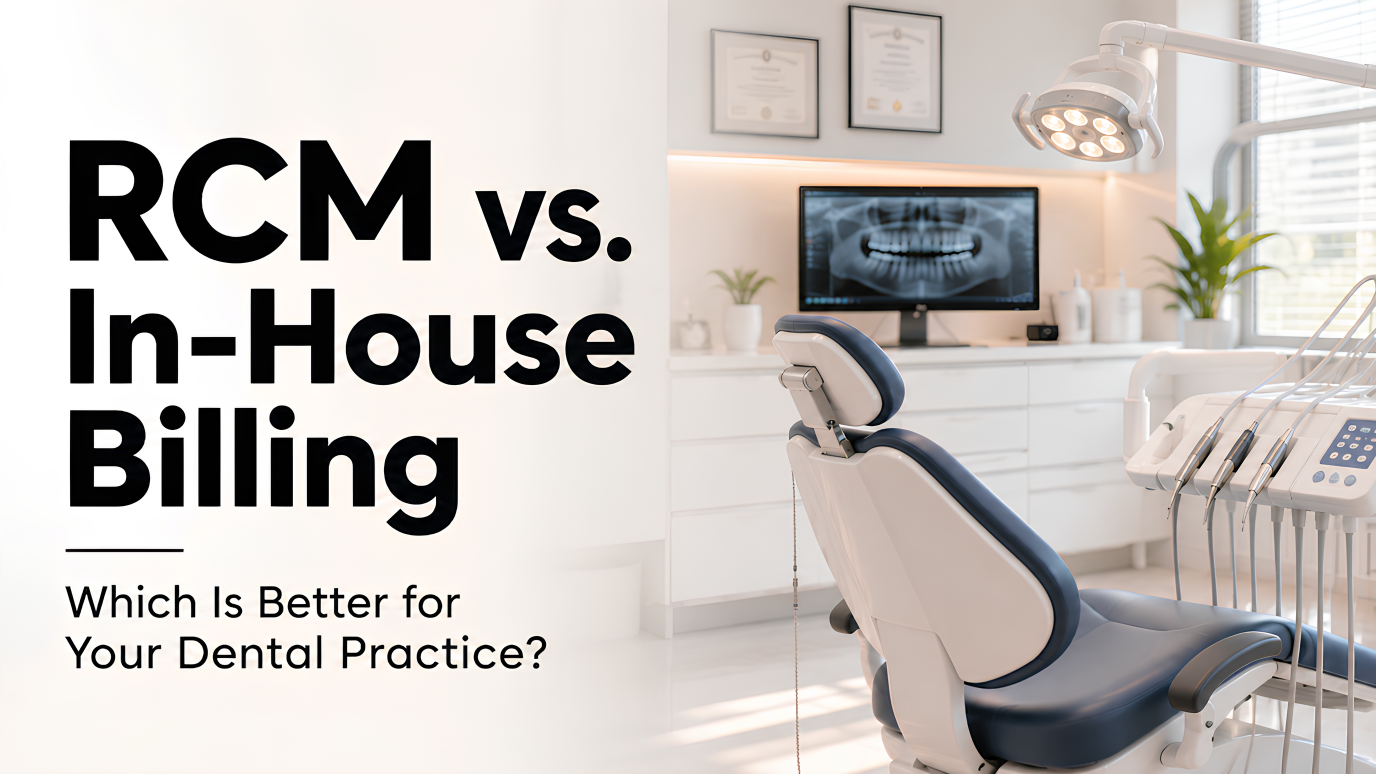
For most dental practices, outsourcing to a professional Dental Revenue Cycle Management (RCM) service reduces claim denials, accelerates reimbursements, and lowers overhead, making it the smarter long-term choice over managing billing in house. Built Easy Solutions specializes in end-to-end dental billing so your team can focus on patient care, not paperwork.
Dental RCM services reduce administrative burden and accelerate cash flow. In-house billing offers control but carries high staffing and training costs. Claim denial rates drop significantly with expert claim denial management services. The best choice depends on your practice size, patient volume, and growth goals. Built Easy Solutions delivers full-cycle dental billing tailored for U.S. dental practices
What Is Dental Revenue Cycle Management?
Dental Revenue Cycle Management (RCM) is the complete financial process that runs behind every patient visit, from insurance verification before the appointment to claim submission, payment posting, denial resolution, and final reconciliation. It’s the engine that keeps your practice financially healthy.
Most dental teams think of ‘billing’ as just submitting claims. But the reality is far broader. A single missed step in the cycle, a wrong code, a late follow-up, or an unworked denial can quietly drain thousands of dollars from your monthly collections.
At Built Easy Solutions, we treat RCM as a proactive, revenue-driving system, not a back-office task. Our team manages every touchpoint in your revenue cycle management for dental practices, so nothing slips through the cracks.
The Hidden Cost of In-House Dental Billing
Managing billing internally feels like the safe, controllable choice. And sometimes it is. But for most dental practices, especially those growing beyond 150+ patients per month, the hidden costs outweigh the perceived benefits.
Common In-House Billing Challenges
High staffing costs. A dedicated billing coordinator averages $45,000–$60,000/year in salary alone, before benefits, PTO, or overtime
- Staff turnover gaps Billing roles have high turnover; every departure creates weeks of follow-up delays
- CDT code changes Dental billing codes update annually; untrained staff submit outdated codes, triggering denials
- Denial backlogs. Without a structured workflow, denied claims quietly age past the appeal window
- Zero scalability. Patient volume spikes don’t come with extra billing hours; something always gets delayed
The American Dental Association estimates practices without dedicated billing expertise lose 5–15% of annual revenue to unresolved claims and billing errors, revenue that should be yours.
What Dental RCM Services Include
Professional dental billing services go far beyond submitting claims. At Built Easy Solutions, our dental RCM services cover the complete revenue cycle:
- Insurance Eligibility Verification — Confirmed before the patient walks in the door
- Accurate CDT Coding — Error-free coding that reduces first-pass denials
- Electronic Claim Submission — Faster processing than paper claims, with real-time tracking
- Claim Denial Management Services — Immediate identification, appeal, and resolution of denied claims
- Payment Posting & Reconciliation — Every payment matched, every discrepancy flagged
- Accounts Receivable (AR) Follow-Up — Persistent follow-up so no claim ages out unpaid
- Revenue Reporting & Analytics — Clear dashboards showing exactly where your money stands
This is the difference between reactive billing and a strategic dental practice management service that actively grows your revenue.
RCM vs. In-House Billing: Side-by-Side Comparison
Use this table to evaluate which model fits your practice best:
Factor | In-House Billing | Dental RCM Services |
Cost | High salary, benefits, and software | Predictable, performance-based fees |
Expertise | Varies by staff; turnover risk | Specialized, dental-focused, always current |
Claim Denial Rate | Often 10–15%+ | Reduced to under 5% with active management |
Scalability | Limited by headcount | Scales seamlessly with your practice |
Technology | Purchased separately | Included in service |
Compliance | Staff-dependent | Built into every workflow |
Reporting | Basic, manual | Detailed, real-time, actionable |
Turnaround Time | Slower due to internal delays | Faster reimbursement cycles |
Bottom line: dental RCM services consistently outperform in-house billing on cost efficiency, denial rates, and scalability, especially for practices with growing patient volumes.
When In-House Billing Still Makes Sense
We believe in being honest. In-house billing can work well under specific conditions:
- Your practice sees fewer than 120–150 patients per month
- You have a long-tenured, highly trained billing specialist with low turnover
- You operate with one primary payer and minimal coordination of benefits cases
- You have the budget for ongoing coding education and billing software
Even in these cases, many practices with in-house teams bring in Built Easy Solutions specifically for claim denial management and AR recovery a hybrid model that captures the best of both approaches.
Why Claim Denial Management Is Your Biggest Revenue Lever
Denied claims are the single largest source of lost revenue in dental practices. Most teams either write them off or let them age past the 90-day appeal window. That’s money permanently off the table. Effective claim denial management services change that entirely.
What a Proper Denial Management Process Looks Like
- Root Cause Analysis — Why was the claim denied? Incorrect code? Missing attachment? Eligibility issue?
- Rapid Re-Submission or Appeal — Acted on within 24–48 hours, not weeks
- Denial Pattern Tracking — Identifying recurring denial reasons and fixing them at the source
- Payer-Specific Protocols—Delta Dental, MetLife, Cigna, and Aetna all have different rules; we know them all
At Built Easy Solutions, our denial management team has recovered significant revenue for practices that had simply accepted denied claims as losses. A structured follow-up process alone can recover 3–8% of monthly collections that were previously written off.
How Built Easy Solutions Handles Dental RCM
Built Easy Solutions isn’t a generalist billing company that handles dental as a side service. We are built specifically around dental practice management services, which means our team knows CDT codes, dental-specific payer rules, PPO fee schedules, write-off calculations, and coordination of benefits inside and out.
Our Dental RCM Process
- Seamless Onboarding—We integrate with your existing practice management software without disrupting daily operations
- Dedicated Account Manager — You get a real person, not a ticket system
- Real-Time Reporting Dashboards — Know your collection rate, AR aging, and denial trends at any moment
- HIPAA-Compliant Workflows — Patient data protected at every step with signed BAAs
- Scalable for Any Practice Size—Solo practitioners, group practices, and multi-location DSOs all use our services
Final Verdict: Which Model Wins for U.S. Dental Practices?
For the vast majority of U.S. dental practices, dental RCM services deliver better financial outcomes than in-house billing. Lower denial rates, faster reimbursements, and a scalable cost structure all point in the same direction.
In-house billing has its place, but it requires consistent investment in people, training, and technology that most practices can’t sustain long-term. Outsourcing to a dedicated partner like Built Easy Solutions means your front desk focuses on patients, your clinicians focus on care, and your billing runs on autopilot, handled by specialists who do this every single day.
The question isn’t whether to optimize your revenue cycle. The question is how soon.
FAQs
What does dental revenue cycle management include?
Dental Revenue Cycle Management covers the entire financial lifecycle of patient care: insurance eligibility verification, CDT coding, electronic claim submission, denial management, payment posting, AR follow-up, and revenue analytics. It’s the complete system from patient check-in to final payment.
Is outsourcing dental billing worth it for small practices?
Yes, especially for smaller practices that can’t afford a full-time, highly trained billing specialist. Outsourcing dental billing services gives even solo practitioners access to expert-level coding, denial management, and AR follow-up without the staffing overhead.
What is the average claim denial rate for dental practices?
Industry averages range from 5% to 15%. Practices that invest in professional dental RCM services typically reduce their denial rate to under 5% through proactive coding accuracy and structured denial workflows.
How much do dental billing services cost?
Most dental billing services charge between 4 and 8% of collected revenue. Unlike fixed salaries, this is a variable cost that rises only when you collect more, making it a low-risk investment with measurable ROI.
How is dental RCM different from medical RCM?
Revenue cycle management for dental practices uses CDT (Current Dental Terminology) codes rather than ICD/CPT codes used in medical billing. Dental billing also involves unique workflows like predeterminations, dual coverage coordination, and dental-specific payer contracts with insurers like Delta Dental, MetLife, and Cigna Dental.
How long before we see results after switching to RCM services?
Most practices see measurable improvement in claim turnaround time and denial rates within 60–90 days of transitioning to a professional dental RCM provider. AR backlog recovery often begins in the first 30 days.
Is our patient data safe with an outsourced billing company?
Reputable dental billing services operate under strict HIPAA compliance — including signed Business Associate Agreements (BAAs), encrypted data transmission, and role-based access controls. At Built Easy Solutions, HIPAA compliance is non-negotiable.
What are claim denial management services?
A claim denial management service is the structured process of identifying denied insurance claims, analyzing why they were denied, resubmitting or appealing them, and implementing preventive measures to reduce future denials. It’s one of the highest-ROI services in dental practice management.